Recapitalizations in CRE
Feb 2, 2026
A recapitalization is when the capital behind a property is restructured without selling the asset. In other words, the real estate stays the same while the debt, equity, or ownership changes.
Most recaps are done to reset leverage, bring in a new capital partner, manage risk, or recycle capital for the next phase of the business plan.
A simple example
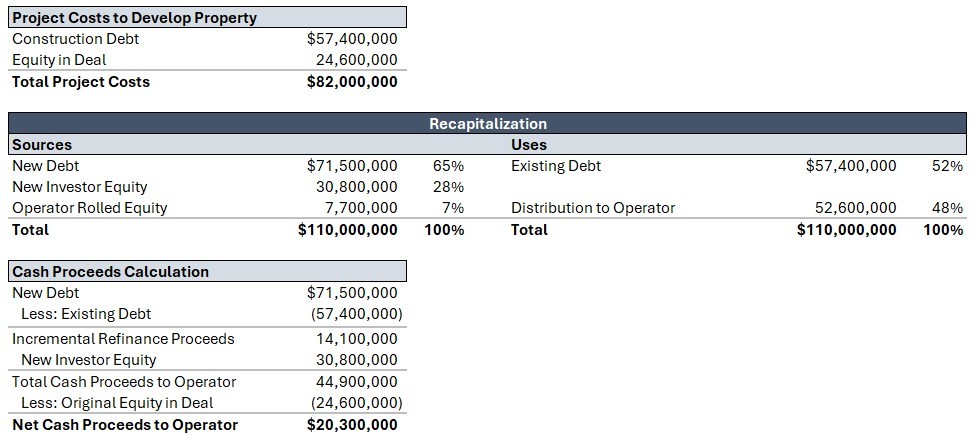
An operator developed a 200-unit apartment complex and is all-in at $82 million of total project costs, consisting of $57.4 million of debt and $24.6 million of equity. At stabilization, the property is appraised at $110 million, or $550,000 per unit.
The operator recapitalizes the deal with new debt at 65% leverage, resulting in $71.5 million of loan proceeds based on the appraised value.
The recap is structured at the $110 million valuation. A new investor contributes 80% of the equity ($30.8 million), while the operator rolls a 20% equity interest ($7.7 million).
The key point here is that the operator is not fully exiting. By rolling equity forward, alignment is maintained between the operator and the new investor, as both parties remain economically invested in the outcome of the deal. Rolled equity is shown to illustrate post-recap ownership; it is not new capital.
After paying off the existing $57.4 million construction loan, there is $14.1 million of incremental refinance proceeds. Combined with the $30.8 million of new equity, total cash proceeds to the operator are $44.9 million.
Given the operator originally invested $24.6 million of equity, this results in net cash proceeds of $20.3 million.
For illustrative purposes, this example reflects a very strong development outcome and is meant to show how capital flows in a recap. Not all recaps look like this.
Important Notes: One of the biggest challenges in any recap is the price; reaching a valuation that the operator is willing to sell at and the investor is willing to buy into.
It’s also worth noting that not all recaps are about profit extraction. In many cases, especially in development, recaps occur because debt was tighter than expected, costs ran higher, timelines stretched, lease-up slowed, or interest reserves were consumed. In those situations, the recap is about stabilizing the deal and preserving long-term upside.
Recaps are one of the most flexible tools operators have. Whether opportunistic or defensive, understanding how the sources and uses flow tells you exactly what problem the transaction is trying to solve.