🗓️
Feb 9, 2026
Equity Kickers in CRE Finance
An equity kicker is a feature in a loan that gives the lender some form of equity participation in addition to contractual interest. It’s typically used when a lender wants upside beyond a fixed yield, often in higher-risk or transitional deals. In other words, the lender is saying “I’ll lend at these terms, but I want a piece of the upside if the deal performs”.
The most common form is profit participation. In this structure, the lender receives a percentage of profits after repayment of principal, interest, and return of equity. The lender does not own equity in the deal, but participates economically if the project performs well.
Example
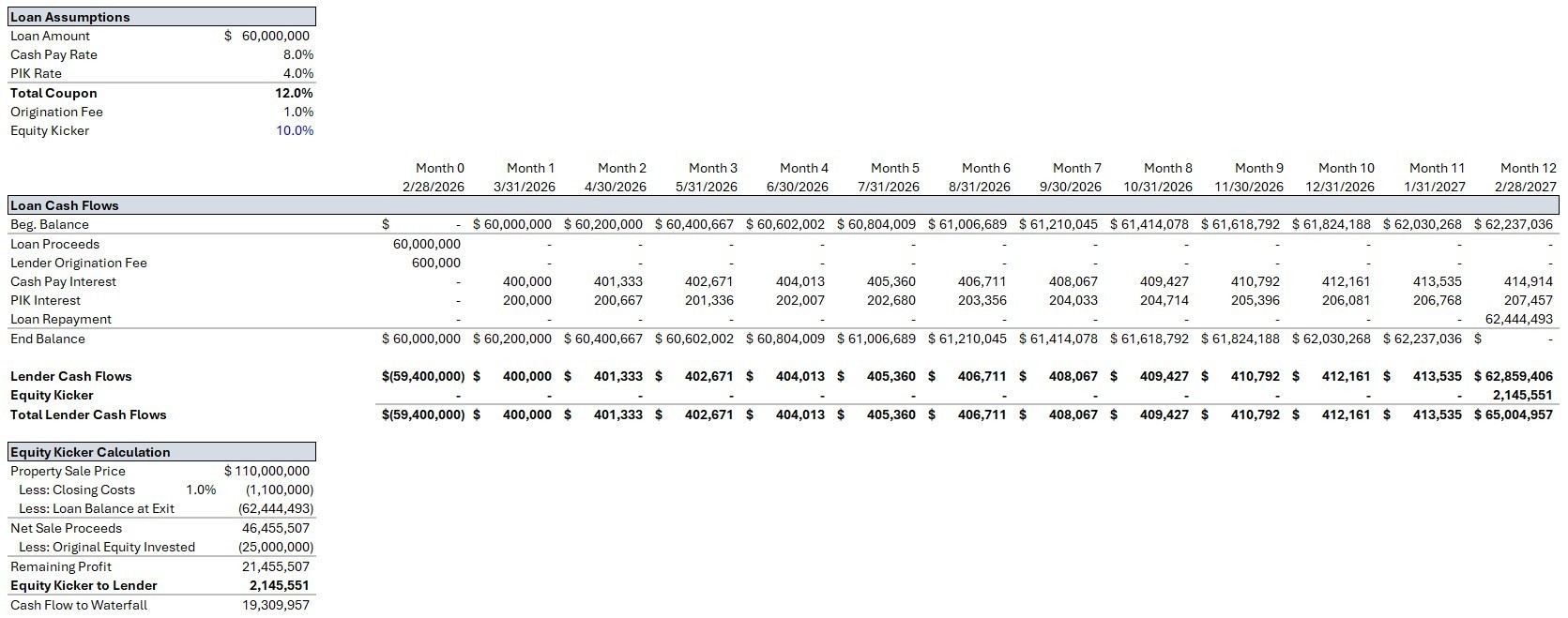
The lender originates a one-year, $60 million loan at an 8% cash pay rate and 4% PIK rate, for a total coupon of 12%, with a 10% profit participation kicker. The property sells for $110 million at the end of the loan term.
After accounting for closing costs and paying off the loan balance (including accrued PIK), net sale proceeds are approximately $46.5 million. The original equity in the deal was $25 million, resulting in roughly $21.5 million of profit after return of equity.
The equity kicker is applied to that profit, resulting in a $2.1 million payment to the lender. The remaining $19.3 million of proceeds then flow through the equity waterfall.
The key point is that the equity kicker sits outside the traditional equity waterfall. It’s a loan feature, not a GP promote, and it shifts a portion of the upside from the equity to the lender.
From a returns perspective, the lender earns a 13.9% IRR and a 1.13x MOIC without the equity kicker. With the equity kicker, the lender’s return increases to a 17.6% IRR and a 1.17x MOIC, highlighting the impact even a relatively small kicker can have on overall economics.
From a capital perspective, the question isn’t whether an equity kicker is good or bad, it’s whether the deal generates enough upside to support it. When a sponsor is also raising equity, the profit pool has to be large enough to absorb the kicker without compressing returns elsewhere in the stack. If that upside is tight, introducing a kicker can quickly strain the structure, which is why this needs to be evaluated early rather than layered in after returns are already compressed.
Important Notes: Equity kickers allow sponsors to access capital that might not otherwise be available on a pure debt basis. For lenders, they provide a way to price risk when cash yield alone is not sufficient. For operators, they can reduce current pay rates at the cost of sharing future upside.
Because equity kickers sit outside traditional interest payments, they directly affect exit proceeds and sponsor economics, even when the percentage seems small. Understanding how these structures work is important as they can materially change the true cost of capital and the final outcome of the transaction.