How Capital Structure Changes the Same Deal – Preferred Equity
When evaluating a deal, capital structure plays an important role in how well an investment actually performs. Two investments can show identical unlevered returns, yet behave very differently once real capital is layered into the stack. The difference comes down to how risk, timing, and flexibility are distributed between debt and equity.
Example
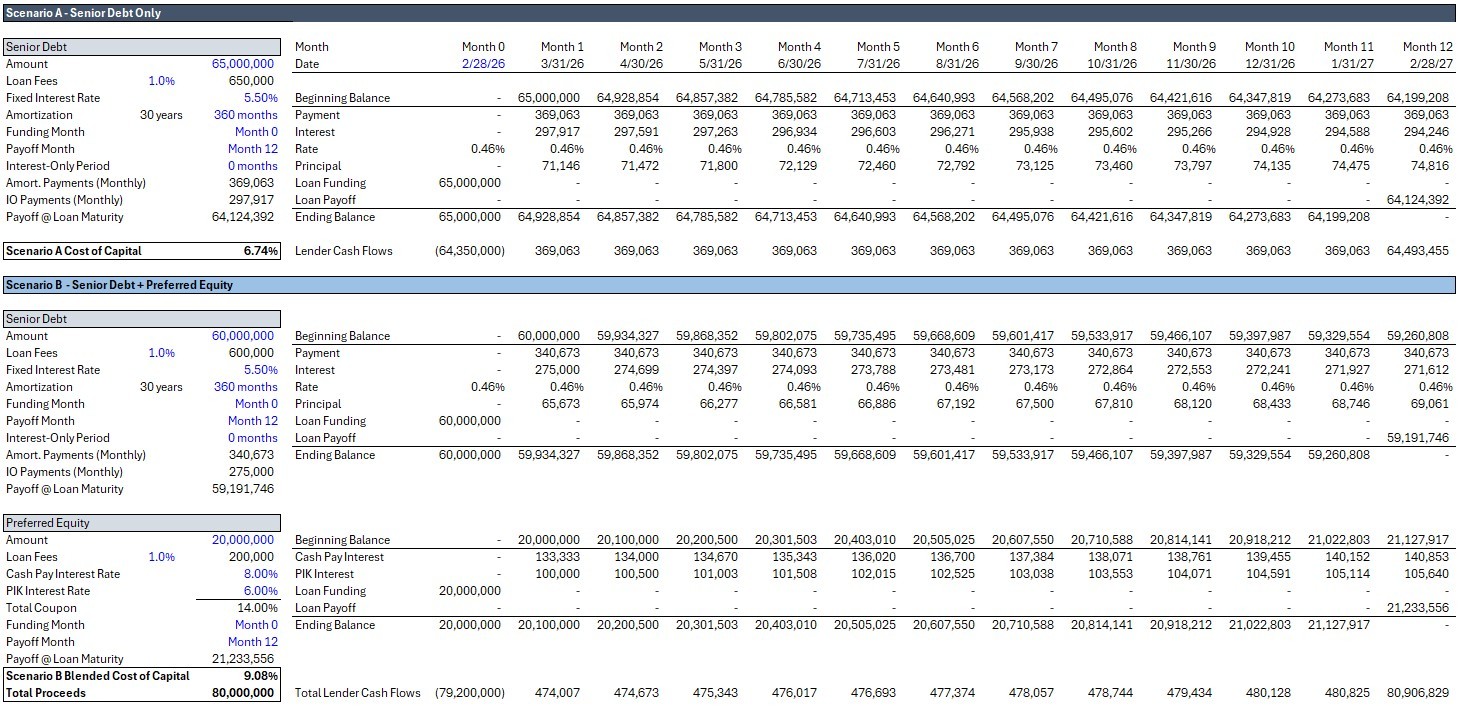
An operator is acquiring a 250-unit multifamily property for $100 million, or $400,000 per unit. Two financing structures are being evaluated:
Scenario A – Senior debt only:
65% LTV
5.50% fixed interest rate
30-year amortization
Scenario B – Senior debt + preferred equity:
Senior loan at 60% LTV
Additional $20 million of preferred equity (bringing total leverage to 80%)
Preferred equity priced at 8% cash pay and 6% PIK/accrual for a total coupon of 14%
Accounting for fees and timing of payments, the cost of capital in Scenario A is 6.74%, while the blended cost of capital in Scenario B increases to 9.08%, meaning the total debt service is higher.
So why would a sponsor intentionally choose the more expensive structure?
Because capital structure isn’t just about minimizing cost, it’s about positioning risk and execution flexibility across the lifecycle of a deal.
The right capital structure defines:
how much cushion exists if performance slips,
how refinance risk is absorbed,
and how exit proceeds ultimately get allocated.
Preferred equity may increase the overall cost of capital, but it can also:
bridge capital gaps when senior lenders won’t stretch,
improve senior lender comfort by reducing senior leverage and increasing DSCR cushion,
preserve sponsor ownership by avoiding additional common equity dilution,
improve refinancing optionality by lowering the senior loan balance,
and introduce cash flow flexibility through structuring features such as accrual components.
In practice, preferred equity often appears when senior lenders cap leverage based on risk, meaning the structure reflects lender constraints as much as sponsor strategy.
These benefits come with tradeoffs. In terms of order of repayment, preferred equity sits above common equity, which reduces the profit pool available to sponsors and investors. The same structure that improves feasibility can compress returns if the deal’s upside is limited.
This is why strong projected returns alone don’t make a deal financeable. A structure must work across multiple scenarios – base case, downside, and exit – not just under ideal assumptions.
From a capital perspective, the question isn’t simply, “what are the projected returns?”
But also “does the capital stack support execution when reality deviates from the plan?”
Understanding this distinction changes how deals are evaluated. Capital isn’t just funding, it’s a strategic tool that shapes risk, alignment, and ultimately whether a business plan can execute.