How Debt Funds Use Back Leverage to Achieve Equity-Like Returns
Debt funds often originate real estate loans that produce low-to-mid-teens yields; however, the returns generated at the fund level can be significantly higher.
The difference typically comes from back leverage, a structure that allows a debt fund to finance the senior portion of a loan with cheaper capital while retaining the higher-risk exposure. By financing the safer portion of the loan, the fund reduces the amount of its own capital required while preserving the higher-yield economics associated with the subordinate position.
The Basic Structure
A debt fund originates a whole loan on a property, but instead of holding the entire loan with its own capital, the fund introduces back leverage by splitting or financing the loan into senior and subordinate portions. This can be accomplished in several ways:
1) A/B Note Structure
The loan is split into two tranches:
A-Note: the senior portion of the loan, sold to a bank or institutional lender
B-Note: the subordinate portion retained by the debt fund
Because the A-note sits at the top of the loan structure and receives priority repayment, it earns a lower yield. The B-note sits beneath it and therefore captures the remaining loan economics.
2) Repo or Warehouse Financing
Instead of selling the senior portion of the loan, the debt fund finances it through a credit facility secured by a pool of loans. The financing provider lends against eligible loans at a lower cost of capital, allowing the fund to reduce its equity exposure and recycle capital as loans are originated and repaid.
3) Note-on-Note Financing
In this structure, the fund raises financing secured by an individual loan. The lender effectively funds the senior portion at a conservative attachment point, while the debt fund retains the subordinate exposure.
While the structures vary, the economic logic is the same: the safer portion of the loan is financed with a lower cost of capital, while the debt fund retains the higher-risk portion that generates higher returns.
Example
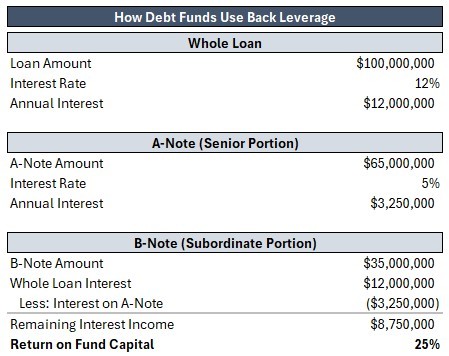
A debt fund originates a $100 million bridge loan at a 12% coupon. If the fund held the entire loan with its own capital, the economics would be straightforward. The fund would invest $100 million and earn $12 million of annual interest income, producing a 12% return.
Instead, the fund structures the loan as an A/B note split, where the loan is divided into two tranches:
A-Note (Senior Portion)
$65 million
sold to a bank
priced at 5%
B-Note (Subordinate Portion)
$35 million
retained by the debt fund
The loan still generates $12 million of annual interest income. The bank receives 5% on the $65 million A-note, or $3.25 million. The remaining $8.75 million of interest income flows to the B-note holder. Because the debt fund only has $35 million of capital invested, the return on its capital increases to 25%, even though the underlying loan itself yields only 12%.
Economically, the fund has effectively created a synthetic B-piece investment for itself. The fund retains the part of the loan structure where returns are higher but also where losses would appear first in a downside scenario.
Capital Recycling and Platform Scale
Back leverage also allows debt funds to recycle capital more efficiently. If a fund held every loan entirely with its own capital, the size of its lending platform would be constrained by the size of the fund. By financing the senior portion of loans, the same pool of equity capital can support a much larger loan portfolio. This allows the fund to originate more loans, scale its lending platform, and remain competitive when bidding on transactions.
The Capital Perspective
From a capital perspective, back leverage is ultimately about how risk is allocated across the capital stack. It does not change the risk of the underlying loan; it reallocates that risk across different layers of capital.
Banks and financing providers attach to the safest portion of the loan, where their exposure benefits from significant collateral protection. Debt funds, by contrast, retain the subordinate position, where returns are higher but where losses would appear first as risk migrates through the capital stack.
Key considerations for capital providers include:
the attachment point of the senior financing
the amount of subordinate capital beneath the senior lender
the volatility of the underlying collateral
refinancing or liquidity risk associated with the leverage facility
how quickly losses would migrate through the structure under stress
While back leverage can enhance returns, it also introduces structural risks. If collateral values decline or financing providers tighten lending terms, debt funds may face margin calls or refinancing pressure on their leverage facilities.
Back leverage illustrates how capital structure can fundamentally reshape investment outcomes. What appears to be a traditional lending strategy is often closer to a structured credit investment. Once back leverage is introduced, the debt fund is no longer simply earning a loan coupon, it is effectively holding the subordinate risk position within the loan structure.