🗓️
Mar 2, 2026
How Capital Providers Evaluate Preferred Equity
Preferred equity isn’t evaluated purely on pricing or headline returns. From a capital provider’s perspective, the decision to deploy often begins with a different question:
Where does risk sit in the capital stack and how does it behave if things don’t go according to plan?
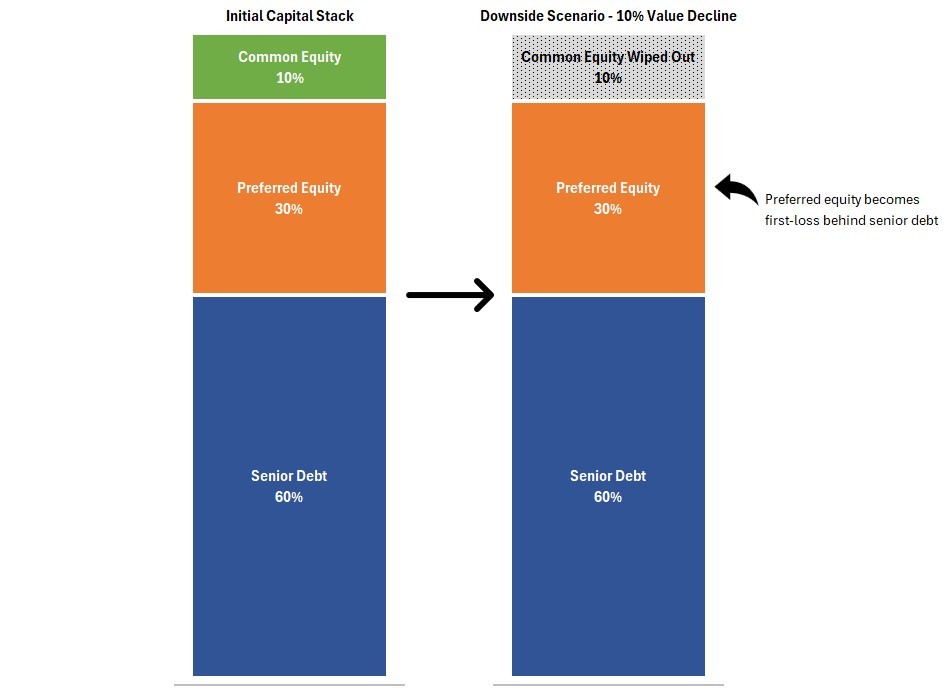
Preferred equity sits beneath senior debt and above common equity in the capital stack. Its risk profile is defined less by its coupon and more by its position relative to the layers above and below it.
Understanding Position in the Stack
Before deploying capital, pref providers typically evaluate:
how much senior debt must be repaid before they see proceeds,
how much equity cushion exists beneath them,
and how far property value could decline before their position is impaired (distance to impairment).
Because senior lenders are paid first, the stability of the senior position becomes critical, not to enhance senior outcomes, but to reduce the probability of stress cascading down the stack.
Leverage and Downside Positioning
Total leverage plays a significant role in how preferred equity behaves. At moderate leverage levels, pref may function as structured risk capital that enhances flexibility within the deal.
But as leverage increases, for example approaching or exceeding 90% LTV, the risk profile begins to change. In downside scenarios where common equity is wiped out, preferred equity effectively becomes first-loss beneath senior debt – meaning the risk profile can begin to resemble common equity while returns remain capped.
This is why capital providers often focus heavily on cushion analysis and downside scenarios rather than base-case projections alone.
Sponsor Alignment and Execution Risk
Preferred equity providers don’t deploy capital simply to preserve sponsor ownership, but they do assess whether sponsor incentives remain strong enough to drive execution. Structures that overly dilute or misalign the sponsor can increase operational risk, which ultimately impacts the pref position. If execution falters through slower lease-up, cost overruns, refinancing pressure, etc., that risk migrates quickly toward the pref layer.
The Real Underwriting Questions
Strong projected returns are rarely the deciding factor. Instead, capital providers ask:
Does the structure maintain stability beneath the senior position?
Is there sufficient cushion before pref capital is impaired?
Is there a realistic path to refinance or exit?
How does the capital stack behave if performance deviates from expectations?
How quickly does risk migrate through the stack under stress?
Preferred equity isn’t just a financing tool; it’s a mechanism for redistributing risk across the capital stack.
The decision to deploy ultimately comes down to whether the structure protects downside exposure, while still offering sufficient compensation for the position’s attachment point within the stack.